- Abano Pass
- 2,826 m (Wikipedia)
- Kvemo Alvani to Omalo
- 80 km, about 4 hours (park)
- Tbilisi to the park
- 195 km, about 6 hours (park)
- Season
- June to October (park)
- Pharmacies and ATMs
- none (park)
- Emergency
- 112
This page is about Georgia the country, not the US state, and is part of the Georgia Travel Guide. Checked on 19 November 2026.
What and where Tusheti is
It is a high, remote valley region on the northern slopes of the Greater Caucasus. Wikipedia calls it "a historic region in northeast Georgia", home to the national park of the same name, with an area of 969 km² and Omalo as its capital.
Neighbours. Wikipedia says the region borders the Russian republics of Chechnya and Dagestan to the north and east, and the Georgian historic provinces of Kakheti and Pshav-Khevsureti to the south and west. Administratively it belongs to Akhmeta, in Kakheti.
Sheep country. Men here traditionally spent "the summer with the flocks of sheep high up in the mountains between April and October", Wikipedia notes, and wintered their flocks in Kakheti. That is why you meet flocks and their dogs on the trails.
The national park. The park's own page says the protected areas "include 11 tourist trails, these are: 1,2,3,4 and 6 day trails". It offers hiking, cycling, horse riding, cultural tours and birdwatching. The park lists its contacts in two villages of Akhmeta Municipality: the main village and Lower Alvani.
Before a trail. The park's visitor guide asks: "Please contact Tusheti National Park Administration before visiting any trail".
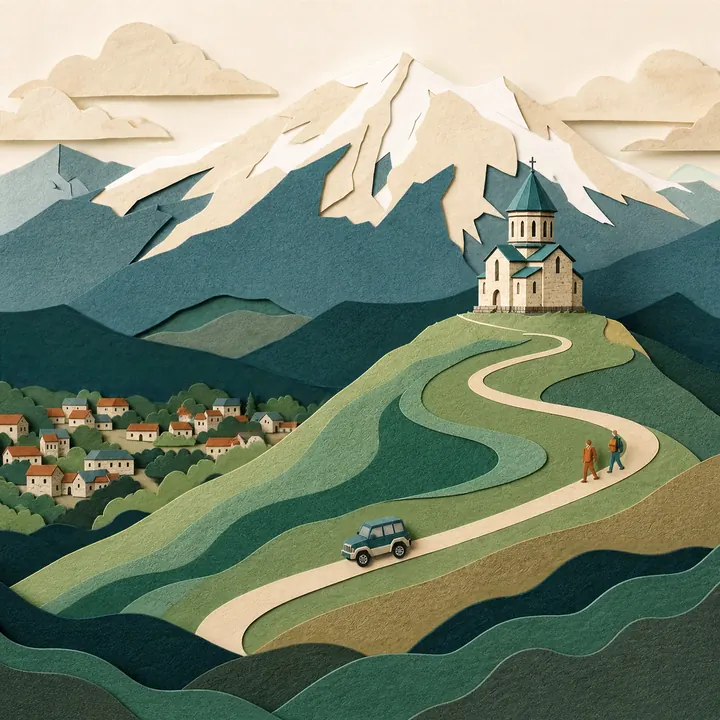
The Abano Pass road to Omalo
The road into the valley crosses the pass, and the last stretch needs an off-road vehicle. The park's guide says: "Transportation from Kvemo Alvani to Omalo is possible only by off road vehicle."
Distances and times. The park's how to get there page gives these averages:
| Stretch | Distance | Time by vehicle |
|---|---|---|
| Tbilisi to Kvemo Alvani (by Gombori) | 130 km | about 1 h 30 min |
| Kvemo Alvani to Omalo | 80 km | about 4 h |
| Tbilisi to the national park | 195 km | about 6 h |
Taxis. "From the centre of Kvemo Alvani high-vehicle taxies travel daily towards Tusheti National Park," the same page says.
The pass. Wikipedia calls the Abano Pass "one of the highest drivable mountain passes in the Caucasus", linking Kakheti to the south with Tusheti to the north. It adds: "The damaged road surface allows only 4x4 vehicles to go through."

Rain, snow and landslides. The UK safety advice warns that "heavy rain, flooding and snow at higher altitudes can affect roads and bridges making travel difficult or impossible (particularly in remote areas)" and that "landslides are common". In remote areas, it says, "make sure your vehicle is suitable for off-road driving and check weather conditions locally."
Season. "Tourist season lasts from June to October," says the park. We give no dates for this year's opening or closing. Before you set off, check the restrictions page at georoad.gov.ge and ask your driver or host.
Our tip.
- Unless you have real off-road experience, go with a local driver.
- Start early and arrive in daylight.
- Keep a spare day at the end of the trip in case weather shuts the road.
More on mountain roads is in our guide to driving in Georgia.

Altitude on the pass
At 2,826 m, the pass is above the 2,500 m line that TravelHealthPro, a UK travel health site, uses for altitude illness: it says the illness occurs in people "ascending rapidly to high altitude, usually above 2,500m".
Why the crossing itself is low risk. The factsheet rates risk by sleeping altitude: "The altitudes correspond to sleeping altitude". It adds that symptoms "typically… occur 6–10 hours after ascent to >2,500m". A drive over the top is short; what matters more is how high you sleep.
Where you sleep. We give no altitude for the villages beyond the pass: we found no official figure, so we cannot say how high you will sleep.
Our tip.
- If you get a headache, feel sick or dizzy on the way up, tell the driver and do not linger at the top.
- Drink water during the drive.
- If you have a heart or lung condition, ask your doctor before the trip.
The signs of altitude illness and what to do are in our altitude guide for Gudauri.
No pharmacies, ATMs or petrol: what to bring
Bring everything you need with you. The park warns: "Tusheti is a remote region, and as such there are no amenities such as petrol stations, pharmacies, beauty salons, banks, ATMs or currency exchanges booths."

What the park advises. Its guide says visitors "are advised to wear coarse cloth trousers and high-top shoes" and to "Take food and water to the field".
Our tip: pack for the whole stay.
- Medicines. Bring all your regular medicines for the whole trip plus the spare days, in their original packs.
- A first-aid kit. Plasters, blister dressings and a painkiller you know suits you.
- Cash. No banks or ATMs: carry enough for the whole stay, already in lari.
- Fuel. With no petrol stations, plan the round trip before the climb, or travel by taxi.
- Food and water. Carry them on every trail.
- Clothes. Coarse trousers, high-top shoes and a warm layer.

Tusheti National Park rules and local customs
Keep to the signed paths, stay well back from gorge edges and keep out of local shrines. These rules come from the park's visitor guide.
Visitors may:
- walk along the signed path, on foot or on horseback;
- rest only in designated camping and picnic areas;
- light a camp fire only at designated sites;
- drive only on designated roads.
Visitors may not:
- climb trees and cliffs, or "approach the edges of gorges by more than half a meter";
- "Move swiftly in case of limited visibility (mist, high bushes or grass)";
- bring pets into the park;
- litter, write graffiti or yell and shout loudly;
- "Enter the territory of locally-revered shrines".
Pork. The park says that "pigs are taboo for local people and for this reason, food made from pork is forbidden". It adds: "Local people consider it disrespectful for visitors to bring pork" to the region.
Shrines. "According to local traditions, women are forbidden from entering local sacred shrines and sanctuaries," the park says, and its rules bar all visitors from shrine grounds.
Our tip.
- Check your packed food: no ham, bacon or pork sausage.
- If you are not sure whether a place is sacred, ask your host and stay outside.
- In mist, stop and wait rather than hurry on.
Shepherds' dogs and rabies
In summer you may meet dogs guarding the flocks; a bite or even a scratch needs a doctor. The park's guide says: "During the tourist season visitors may encounter shepherds' dogs".
Rabies. The UK health advice lists "rabies – treatment is available in Tbilisi and major towns. If you're bitten or scratched by a dog, get medical attention immediately."
What that means in Tusheti. Treatment is in Tbilisi and major towns, and from the valley any town is hours away: the park puts Telavi at about 4 h 30 min. Our tip: after a bite, end the trip and go down at once.

Our tip: near a flock.
- Walk round the flock in a wide arc.
- Do not run, and do not feed or stroke the dogs.
- If a shepherd is near, wait for them to call the dogs off.
- Ask your doctor about a rabies vaccine before the trip.
What to do after a bite, step by step, is in our rabies guide.
Medical help: far from a hospital
Help can take hours, not minutes. The UK safety advice says: "If you get into trouble during hiking, skiing, adventure travel or extreme sports, the emergency response may be limited."
Limited care. "Outside Tbilisi, medical facilities are limited," says the UK health advice. "Access to medical facilities may be limited in remote areas," adds its safety page.
Rural areas. The Government of Canada's travel advice says: "First responders may not be able to access rural areas."
In an emergency. The UK advice says: "Dial 112 and ask for an ambulance." The park's guide also gives 112 as the emergency number. Here is how to call an ambulance on 112.
A town with clinics. The park puts Telavi 105 km and about 4 h 30 min away. The catalogue of clinics in Telavi on 100doc.ge listed 13 clinics when we checked on 19 November 2026.
Your cover. Visitors need health and accident cover of at least 30,000 GEL for their whole stay; see the entry rule on travel insurance.
Our tip. Tell your host your route and when you plan to be back. Save 112 and your host's number in your phone before the first trail.
Frequently asked questions
Can I drive to Tusheti?
When is the road open?
How long is the drive from Tbilisi?
Are there pharmacies or ATMs?
Are shepherds' dogs dangerous?
Can I get altitude sickness on the Abano Pass?
Sources
- National Parks of Georgia: park page and visitor alerts ↑
- National Parks of Georgia: visitor guide and park rules ↑
- National Parks of Georgia: how to get there ↑
- georoad.gov.ge: road restrictions ↑
- Wikipedia: Tusheti (secondary source) ↑
- Wikipedia: Abano Pass (secondary source) ↑
- TravelHealthPro: altitude illness ↑
- GOV.UK travel advice for Georgia: health ↑
- GOV.UK travel advice for Georgia: safety and security ↑
- Government of Canada: travel advice for Georgia ↑
This guide is general information, not medical advice: the doctor decides on your care.