- Lines
- 2
- Stations
- 23
- Length
- 27.3 km
- Fare
- 1 GEL / 90 min
- Hours
- 06:00–00:00
- Emergency
- 112
This page is about the metro in Tbilisi, the capital of the country of Georgia. Checked on 20 November 2026.
Tbilisi metro map: lines and stations
The map is simple: two lines, 27.3 km in all.
Two lines. According to Wikipedia, the Akhmeteli–Varketili line has 16 stops, from Akhmeteli Theatre to Varketili, and the Saburtalo line has 7, from Station Square 2 to State University. The diagram below shows all Tbilisi metro stations.
History. The system opened on 11 January 1966 with six stops between Didube and Rustaveli, covering 6.5 km. The newest stop, State University, opened on 16 October 2017.

Changing lines at Station Square
There is only one transfer point. According to Wikipedia, it is listed as Station Square 1 on the Akhmeteli–Varketili line and Station Square 2 on the Saburtalo line.
Key stations: Rustaveli, Liberty Square, Didube and Avlabari
Rustaveli and Didube opened with the first line in 1966; Liberty Square and Avlabari followed in 1967. Wikipedia places all four on the Akhmeteli–Varketili line.
- Rustaveli. Rustaveli metro station was one of the six original stops. According to Wikipedia, it stands next to the Shota Rustaveli statue at the end of Rustaveli Avenue.
- Liberty Square. TTC's Georgian history page names the Liberty Square metro station თავისუფლების მოედანი (Tavisuplebis Moedani, "Freedom Square").
- Didube. Didube metro station was also one of the first six. For minibuses from there, see our Marshrutka in Georgia guide.
- Avlabari. It hosts one of the two "problem card" centres (see below).
How to pay for the Tbilisi metro: price and cards
One tap costs 1 GEL and gives 90 minutes of unlimited travel on the metro, buses, minibuses and the Bagebi–University cable car, according to Tbilisi Transport Company. You pay with Metromoney or with a bank card. TTC's tariff page notes that on buses with a cash register, paying by mobile app or cash does not give the 90-minute package.
Travel passes. These are sold only on a subscription card: 3 GEL for a day, 20 for a week, 40 for a month, 100 for three months, 150 for six months and 250 for a year.
Rike–Narikala cable car. It has its own price: 2.5 GEL one way.
Discounts. Reduced and free fares are tied to registration, study or work in Tbilisi; tourists are not on the list.
Fines. The fare-dodging fine on municipal transport is 5 GEL, or 50 GEL if unpaid within 30 days.

Metromoney card: buy, top up, refund
Metromoney costs 2 GEL and is sold across the metro and at the Rike–Narikala ticket office. It is not personal and needs no documents. Bank of Georgia express branches sell it too.
One Tbilisi metro card for the city. It works on the metro, buses, minibuses and the Rike–Narikala cable car.
Top up and balance. Top up at any ticket office on the network, at both Rike–Narikala stops, at Bank of Georgia express machines or at service centres. The turnstile shows your balance.
Refund. You can return it within one month and get the 2 GEL back with the receipt.
Lost or damaged. Keep the receipt: without it, a lost or damaged one cannot be restored. A damaged one is replaced free at the centres at Avlabari and Medical University, unless the damage is mechanical.
Paying with a bank card
Tbilisi Transport Company says you can pay with Metromoney "as well as with different bank cards". Its tariff page does not list which banks or networks those are.
Our tip: carry Metromoney as a backup, in case yours is not accepted.
Tbilisi metro hours and intervals
Georgia's national tourism administration puts it plainly: "Tbilisi Metro working hours are as determined: from 06:00 to 00:00 every day."
Intervals. According to Wikipedia, trains come every 2½ minutes at peak times and up to every 12 minutes later at night.
Check before you go. The TTC app (Android and iOS) and transit.ttc.com.ge have a Journey Planner and Timetables.
How to ride the metro, step by step
Whether you call it the metro or the subway, riding it takes six steps:
- Have Metromoney or a bank card ready.
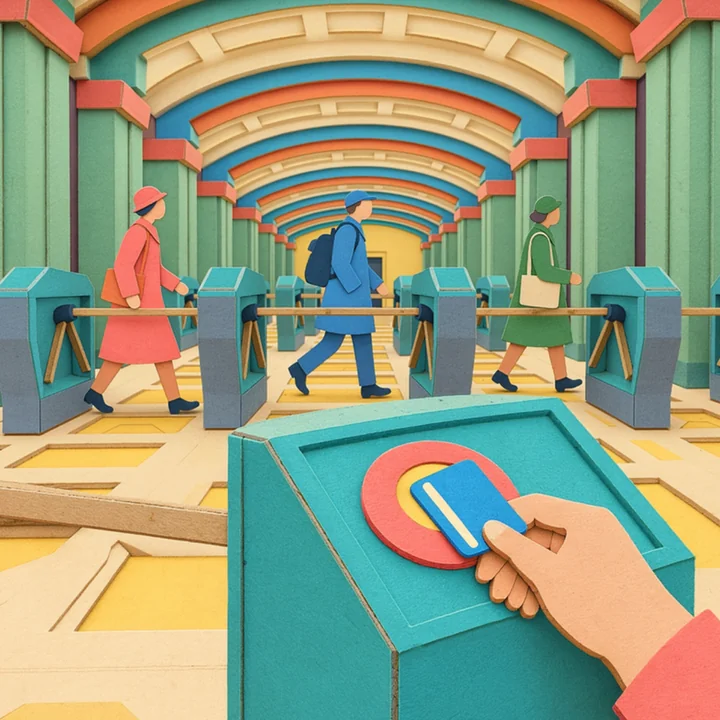
- Use it at the turnstile; with Metromoney, the turnstile also shows your balance.
- Keep the purchase receipt.
- To change lines, ride to the interchange.
- Within the same 90-minute window, carry on by bus at no extra cost.
- Plan the route with Journey Planner in the TTC app.
Our tip: before going down, find the end stop of your direction on the map above, so you board the right train.
Is the Tbilisi metro safe?
The Government of Canada puts it this way: "Buses and the Tbilisi metro are generally safe and reliable, but pickpockets may target tourists." For Georgia as a whole, GOV.UK writes that "crime levels are low".
Day and night in the capital. See our guide Is Georgia Safe to Travel in 2026?
Rush hour and pickpockets
Petty crime such as bag snatching happens, especially in crowded urban areas and at public gatherings.
What official advice says. Carry little cash, keep your documents secure and do not show signs of wealth. Take sensible precautions, particularly in crowded places, stay aware of your surroundings and keep your phone charged and with you.
Our tip: at rush hour, wear your backpack on your front and keep your phone in an inside pocket.
Deep stations and escalators
According to Wikipedia, most stations are very deep, like those of other Soviet-built systems. Of the 23, 21 are below ground and two are at surface level; of the underground ones, 17 are deep-level and four shallow, as of 2018, a split the article marks as lacking a citation. The same source says three escalators at Station Square will be replaced and 36 others modernised to save energy, under a reform plan due by 2029.
Planned upgrades. In July 2024 the EBRD wrote that 12 stations were to be rehabilitated and upgraded, with better lighting and ventilation and more energy-efficient escalators.
Our tip: on the ride up or down, hold the handrail, keep children close and carry bags in your hand.

Late evening on the metro
Georgia's tourism administration gives 00:00 as the closing time. Exact times vary by stop, and late in the evening you may wait up to 12 minutes for a train, according to Wikipedia.
After dark. "Take usual precautions after dark in unfamiliar areas," GOV.UK advises for Georgia in general.
Protests. Demonstrations in Tbilisi centre on the Parliament building on Rustaveli Avenue, can spread, especially on Saturday evenings, and "may lead to travel disruption". The Government of Canada adds that they can disrupt public transportation.
Luggage, strollers and wheelchairs
We found no official information from Tbilisi Transport Company on lifts or on rules for strollers and luggage, so check with staff before you travel. According to Wikipedia, the reconstruction of Gotsiridze was completed in March 2023 with new elevators and tactile paths. The same source reports an October 2022 plan to make 11 stations wheelchair accessible by 2029.
What is planned. In July 2024 the head of TTC said the EBRD-backed project was in its early design stages, which "will include accessibility for disabled people". The company says new rolling stock "will significantly improve accessibility".
Official tourism site. Georgia's national tourism administration says nothing about the metro on its accessibility page.
If something happens in the metro: call 112
Georgia has one emergency number for the police, fire and rescue, and ambulance, and it answers 24/7. If someone threatens or attacks you, GOV.UK advises: "call the emergency number 112 and ask for the police".
What to say. Give your exact location (the name of the stop), what happened, which service you need, and your name and surname. Details: Ambulance in Georgia.
Languages. Call-takers handle Georgian, English, Azerbaijani, Armenian, Turkish and Russian. Deaf and hard-of-hearing callers can use video and text, 24/7.
Signal. Your phone must be within the coverage of a mobile operator; the 112 service lists Magticom, GeoCell or Beeline.
Our tip: if you have no signal on the platform, tell the staff or go up to street level and call from there.
Not urgent. In a life-threatening emergency, call 112 first. For anything that can wait, find a doctor in the catalogue of doctors and clinics in Tbilisi on 100doc.ge.

Metro, buses and cable cars on one fare
The same tap covers buses, minibuses and the Bagebi–University cable car. The rest of Tbilisi public transport, taxis included, is in our Tbilisi guide. The Tbilisi bus from the airport, bus 337, is in Tbilisi Airport Arrival.
Frequently asked questions
How much is the metro in Tbilisi?
What are the operating hours of the Tbilisi Metro?
What time is the last metro?
How many metro stations are there in Tbilisi?
Is the Tbilisi metro safe?
How deep is the Tbilisi metro?
Can I pay with a bank card?
Sources
- Tbilisi Transport Company: Stakeholder Engagement Plan for new rolling stock, 2024 (PDF) ↑
- Tbilisi Transport Company: Non-Technical Summary, 2020 (PDF)
- Tbilisi Transport Company: history (in Georgian) ↑
- Tbilisi Transport Company: about us
- Tbilisi Transport Company: tariffs ↑
- Tbilisi Transport Company: the transport card ↑
- Tbilisi Transport Company: preferential fares ↑
- Tbilisi Transport Company: payment control ↑
- Tbilisi Transport Company: Journey Planner and timetables ↑
- Georgian National Tourism Administration: opening hours in Georgia ↑
- Georgian National Tourism Administration: accessibility ↑
- Government of Canada: travel advice for Georgia ↑
- GOV.UK travel advice for Georgia: safety and security ↑
- GOV.UK travel advice for Georgia: getting help ↑
- Georgia's emergency service: about the single emergency number ↑
- Georgia's emergency service: languages, deaf callers and coverage ↑
- EBRD: Tbilisi gets greener and more inclusive, 2024 ↑
- Wikipedia: the city's metro system (secondary source) ↑
- Wikipedia: list of the city's metro stations (secondary source) ↑
This guide is general information, not medical advice: the doctor decides on your care.