- Height
- about 40 m
- Mountaineers visited the monuments
- 1944
- To the village church from Kutaisi
- about 1.5 h
- To the village church from Tbilisi
- about 3 h
- Emergency
- 112
This page is about Georgia the country, not the US state, and is part of the Georgia Travel Guide. Checked on 22 November 2026.
Where is the Katskhi Pillar, and is it worth visiting?
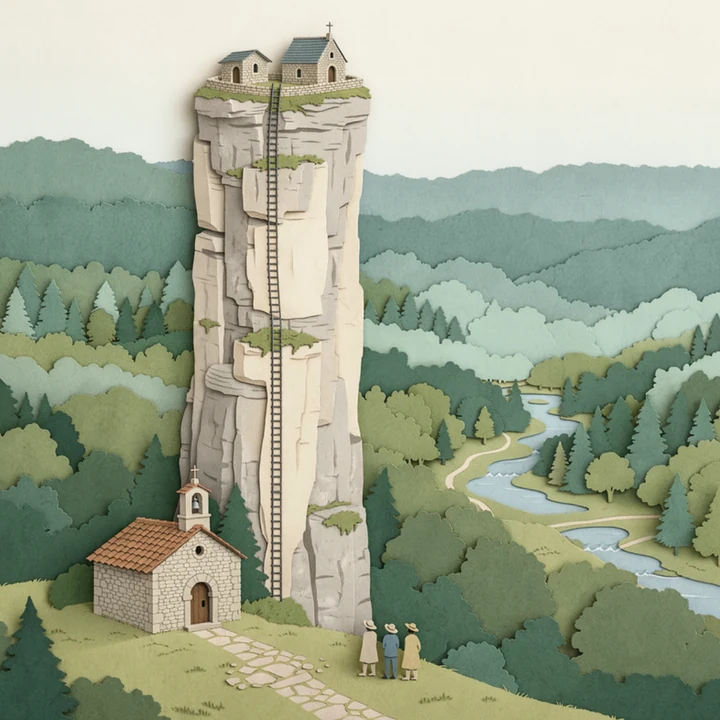
It rises by the village of Katskhi in Chiatura Municipality, Imereti, on the watershed of two rivers: the Katskhuri, a right tributary of the Kvirila, and the Gvitori. The municipality's tourism page calls it the Katskhi column and gives its height as 40 m.
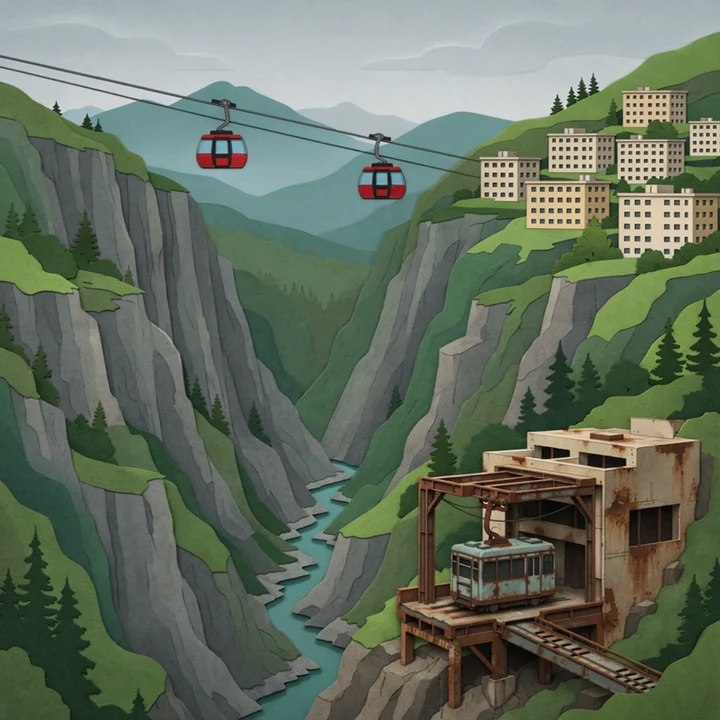
The nearest town. The municipal centre lies 72 km from Kutaisi, the centre of the region, by the municipality's own figure. The town's cable cars and other sights are in our Chiatura guide.
Is it worth the trip? The national tourism site calls the pillar "the truly remarkable sight" of the country.
Our tip. Go if a view from the ground and the sites at its foot are enough for you. Do not build the day around reaching the top.
Can you climb the Katskhi Pillar?
No, according to the national tourism site: ordinary visitors are forbidden to go up, and the hermit monk who lives on top usually meets visitors on the ground.
The site notes that the rock tapers towards its base, which makes the ascent hard, and adds that "the common people are forbidden to do that".
Why the official sources disagree
Three official sites give three different answers. None of the three pages shows a publication date.
The municipality. Its tourism page says that until recently nobody could go up without mountaineering equipment. Then it adds: "At present, it is possible to climb Katskhi column for everyone."
The regional administration. The Imereti Regional Administration says going up "is possible only for alpinists".
No official act. We could not find any official act banning the ascent or dating a ban, so follow the tourism site and any signs or instructions on the spot.
Our tip. Do not step onto a ladder or ask to be let up, even if the way looks open. Take your photos from the ground: this is a place of prayer, not a viewing platform.

What you can see from the ground
The tourism site lists a 6th-century Bolnisi cross carved into the base of the rock, a church on its western side that is open to visitors, and a wine cellar with eight qvevris.
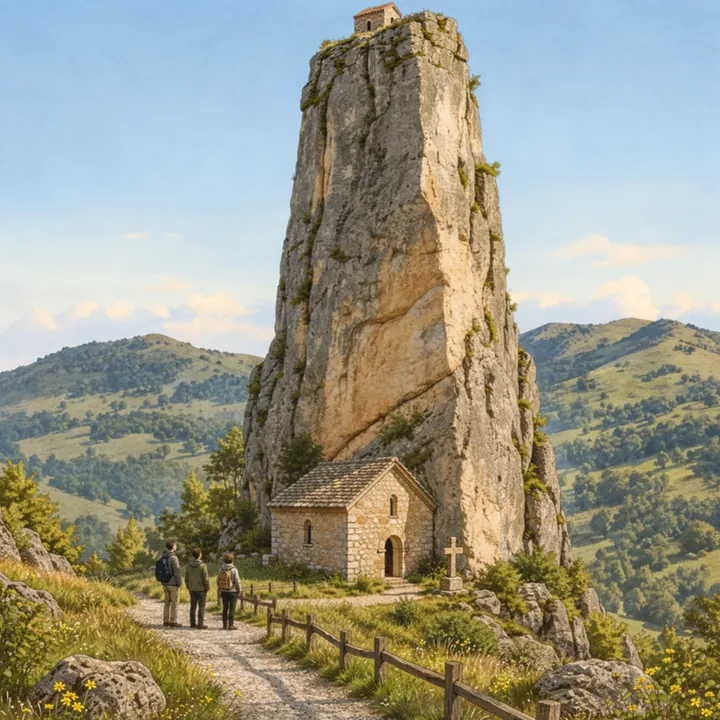
Restored chapels. The chapels at the foot of the column have been restored, according to the municipality.
Our tip. Near the small monastery below, speak quietly and ask before you photograph people.
What is on top of the pillar?
Two small churches are on its upper platform; the municipality's page describes them as ruins.
History. A group of mountaineers visited the monuments of the column in 1944, the municipality notes. Restoration of the buildings on top began in 2007 with money from the Cultural Heritage Protection and Survival Fund.
Katskhi Church in the village: a separate site
This is a different building, in the village rather than at the rock. The tourism site calls it "a functioning temple, where you can enter freely".
The building. It has six semicircular apses. In 1924 the Soviet government closed it, and until 1990 all attempts to restore it were unsuccessful, the tourism site says.
Its age. The municipality's tourism page dates it to the early 11th century and says most of it went up between 1010 and 1014. The regional administration calls it a 10th-century building.

Visiting the churches: what to wear
We found no official dress code for either site.
Our tip. Dress modestly, as you would at any Orthodox place of worship. What that means in practice is in Visiting Churches.
How to get to the Katskhi Pillar
By car it takes about 1.5 hours from Kutaisi and about 3 hours from Tbilisi, the tourism site says. Those times are to the village church, which the site places "very close" to the pillar. We found no official distance to the rock itself.

By car from Kutaisi or Tbilisi
The municipality gives 72 km from the regional centre to the nearest town.
From the capital. We quote no road distance: the sources disagree, and one of their figures is by railway. What to expect on the way is in Georgia Roads: What to Expect.
Our tip. Drive there and back in daylight.
Without a car: train and marshrutka
Without a car, we cannot confirm a direct route. The national railway's schedule lists a train from Kutaisi to Sachkhere; we found no Katskhi stop in the timetable.
Shared vans. There is no official marshrutka timetable to the village that we could find. The Government of Canada's travel advice warns: "Mini-buses called 'marshrutka' are poorly maintained … Avoid using them." The advice is general, not about this route. In the capital, see Didube: Where Many Minibuses Leave From. For the nearest town, read How to Get to Chiatura.
Our tip. Do not count on a late van back. Agree a taxi for the return trip in advance.
Staying safe at the foot of the pillar and on the road
The sources point to two risks on this trip: landslides and weather on mountain roads. The UK government's advice warns that "landslides are common" and that snow at higher altitudes can affect roads.
Weather and trails. The Government of Canada's travel advice says: "Outdoor activities, such as zip-lining, rock climbing or trekking, can be dangerous. Trails are not always marked and weather conditions can change rapidly." It also warns: "Heavy rains may result in significant flooding and landslides".
Our tip.
- Stay on the path and behind any railings. Hold children's hands near the edge.
- Wear shoes that grip, and take the way down slowly after rain.
- Do not stand right under the rock if stones are falling.
- Head back in daylight, and save 112 in your phone before you set off.
Minor injuries. For a bruise or a twisted ankle, see Sprains, Blisters and When to Call 112. Drivers: Night Driving, Mountains and Winter.

Medical help near the Katskhi Pillar: 112 and the nearest city
Call 112. The UK government's health advice says: "Dial 112 and ask for an ambulance." It also warns: "Outside Tbilisi, medical facilities are limited."
Calling 112 from the pillar
One number handles every emergency, and you can speak English. The 112 service says it "receives emergency calls 24/7 throughout the whole country", and its call-takers handle English and five other languages.
The app. The Government of Canada's advice adds: "You can also use the 112 Georgia mobile application".
Our tip. Say the place first: "Katskhi village, Chiatura Municipality, Imereti". Then give a landmark: the church at the foot, the path or the road. On the road, say which way you were heading. More in What to Tell the Operator.

Where is the nearest doctor?
Plan on Kutaisi, the regional centre. We found no official address for a hospital closer to the rock, so we name none.
Rural areas. The Government of Canada's advice notes: "In rural areas, there are shortages of medical supplies and personnel."
In the city. See Hospitals and Doctors in Kutaisi, or a catalogue of doctors and clinics on 100doc.ge.
Before the trip. Check the entry rule on travel insurance: Insurance to Enter Georgia.
Frequently asked questions
Can you climb the Katskhi Pillar?
Is the Katskhi Pillar worth visiting?
Where is the Katskhi Pillar?
How do I get there without a car?
Can I go inside the churches?
Is it safe to visit?
Sources
- Georgian National Tourism Administration: Katskhi Pillar ↑
- Chiatura Municipality: Tourism (undated page) ↑
- Chiatura Municipality: About the municipality ↑
- Imereti Regional Administration: Chiatura ↑
- Georgian National Tourism Administration: Katskhi Church ↑
- 112 Georgia: languages and service ↑
- GOV.UK travel advice: health ↑
- GOV.UK travel advice: safety and security ↑
- Government of Canada: travel advice for Georgia (updated 27 August 2026) ↑
- Georgian Railway: general train schedule (Russian) ↑
This guide is general information, not medical advice: the doctor decides on your care.