- From Kutaisi
- 9 km (Wikipedia)
- Spring water
- 33–35 °C (Wikipedia)
- Sanatoriums at the peak
- 22 (Wikipedia)
- Resort course
- 14–21 days (resort site)
- Emergency
- 112
This page is about Georgia the country, not the US state, and is part of the Georgia Travel Guide. Checked on 19 November 2026.
What Tskaltubo is
It is a small town in western Georgia, built around warm mineral springs. Wikipedia calls it "a spa resort in western Georgia". It adds: "It is the main town of the Tsqaltubo Municipality of the Imereti province."
The springs. The town "is known for its radon-carbonate mineral springs, whose natural temperature of 33–35 °C (91–95 °F) enables the water to be used without preliminary heating", according to Wikipedia.
A Soviet spa. In 1931, a decree of the government of the Georgian SSR made the town a spa resort and balneology centre. "At its height in the 1960s and 70s, the town contained 22 sanatoriums," Wikipedia says. In Soviet times it was "attracting around 125,000 visitors a year".
What the resort focused on. Wikipedia describes the resort's focus as "balneotherapy for circulatory, nervous, musculo-skeletal, gynaecological and skin diseases". Since the 1970s, it adds, the resort's repertoire "has included 'speleotherapy'". We report this as history, not as a promise.

Radon baths and Spring No. 6
You bathe at the springs themselves, in bathhouses such as Spring No. 6, not in your hotel. The water has to be used where it comes out of the ground.
Spring No. 6 and Stalin
Wikipedia says: "'Spring No. 6' is the largest thermal bath still in use. It was built in 1950, exclusively for Joseph Stalin." It also notes that "Bathhouse 9 features a frieze of Stalin".
Treatment, not lodging. The resort's booking site (tskaltuboresort.ge) calls Spring #6 "a balneological facility" and "not a hotel". Guests sleep elsewhere and come in for procedures. The site says it is "open every day (including holidays), 365 days a year, during 10:00-17:00".
How a course works
A course usually lasts two to three weeks, and a local doctor chooses the procedures.
Why at the spring. The booking site explains that "the mineral water loses its unique chemical composition and cools down within three to four minutes after release". Treatment uses "continuously flowing fresh mineral water".
How long. "The treatment course in Tskaltubo resort lasts from 14 to 21 days and at least for 10-12 days," the site says.
Who decides. "The attending physician develops an individual treatment program" for each guest, the site says. Patients "are prescribed three to five procedures". Their types and number "are defined by a local doctor, depending on the general health condition of a patient".
Prices. We give none. They come from a commercial site and change.

What WHO says about radon
WHO sees the gas as a health risk in the air you breathe. Its fact sheet does not discuss therapeutic baths.
The gas. In its fact sheet of 25 January 2023, WHO says: "Radon is a naturally occurring radioactive gas". It calls the gas "one of the leading causes of lung cancer" and notes that it "can also be found in water".
Where levels are high. WHO says concentrations "are higher indoors and in areas with minimal ventilation, with highest levels found in places like mines, caves and water treatment facilities".
Smokers. WHO says the gas "is much more likely to cause lung cancer in people who smoke".
What WHO does not say. We found no WHO statement on therapeutic baths, for good or ill, so we make no claim either way. Whether a course suits you is for a doctor to decide.
Our tip. If you smoke, have a lung condition or simply feel unsure, ask your own doctor before the trip.
Who should not take radon baths
The resort's booking site lists who should not take the baths.
"Specific contraindications for radon therapy are: 1. Radiation sickness; 2. Hypothyroidism; 3. Hypoestrogenism; 4. Individual intolerance to procedures."
Source: the resort's booking site, indications and contraindications (tskaltuboresort.ge).
General contraindications. The same page says "The remaining contraindications are common for balneotherapy". Among them it lists:
- "All diseases in the acute phase";
- "Acute infectious diseases before the end of isolation period";
- "Malignant neoplasms";
- "Repetitive or heavy bleeding";
- "Pregnancy in all periods – for the spa resorts and mud…"; the same page adds that "in all stages of pregnancy one should not treat a pregnant female" with "radon baths" for extragenital diseases;
- "Epilepsy".

Our tip.
- Bring a short medical summary and a list of your medicines, in English if you can.
- Tell the bathhouse doctor about any condition on the list, even one that is under control.
- The local doctor decides on your procedures. If the answer is no, accept it.
Hot water in general. For who should take care in hot baths, see the health section of our Tbilisi sulfur baths guide.
The abandoned sanatoriums
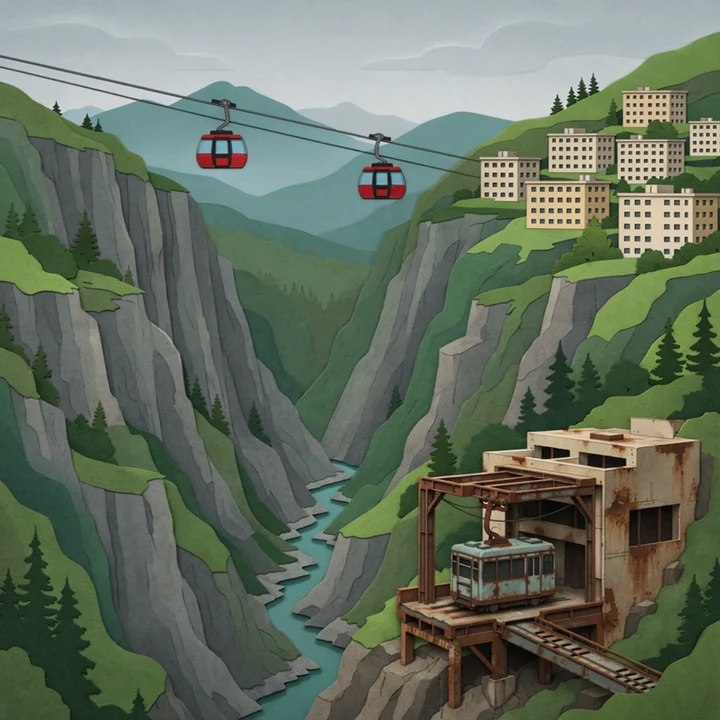
Wikipedia says most of the Soviet sanatoria are now abandoned and in ruins; some have housed refugee families since the 1990s.
After 1991. Wikipedia says that "when the country collapsed in late 1991, the city's sanatoriums were abandoned and turned into housing for Georgian refugees fleeing the War in Abkhazia".
The refugees. The complexes became homes for "some 9000 refugees, primarily women and children", according to Wikipedia. It gives no figure for today.
Today. "Most of the Soviet sanatoria are now abandoned and in ruins," Wikipedia says.

Our tip. We found no official source on whether these buildings are sound. Treat every ruin as unsafe.
- Some of these buildings have been homes for decades and may still be lived in. Do not go inside without an invitation.
- Ask before you photograph people, windows or yards.
- Do not climb into ruined blocks: floors, stairs and roofs can give way.
- Stay on open ground and keep children close.
Dogs. If a dog bites or scratches you, the UK health advice says: "get medical attention immediately". See our rabies guide.
Sataplia Nature Reserve
Sataplia is a protected area in the same municipality, with dinosaur footprints, a cave and a glass viewpoint.
What you see. The park's page invites you to "see dinosaur footprints and karst cave". It also points to the "unique colchic forest and glass panoramic view". There are "2 tourist trails", and the reserve lies in Village Banoja, Tskaltubo municipality.
Hours. The page lists "Everyday", 10:00–18:00 in spring and summer and 10:00–17:00 in autumn and winter. The park's visitor guide, however, lists "Working days: every day except Mondays", so it treats Monday as a day off. Guides speak Georgian, English and Russian.
Park rules. The visitor guide says:
- "wear sports shoes";
- "Due to visitors' safety walking on panoramic view is not allowed in rainy and snowy weather";
- do not enter the area with pets;
- in an emergency, call 112.
Our tip. Plan for a day other than Monday, or check with the park first. If heights make you dizzy, skip the glass viewpoint: the trails are enough.

Prometheus Cave. The park's page places it in Village Kumistavi, Tskaltubo municipality: "There are 22 halls found, where just 6 halls are open for tourists." The "1 hour duration trail" ends "within boat tour on River Kumistavi". The cave's hours block says "Everyday", but its visitor guide lists "every day except Mondays", so check before you go. The guide asks you to "wear sports shoes" and warns that "boating is prohibited if the water level rises in the cave". See also our Martvili Canyon guide.
Getting to Tskaltubo
The town is a short drive from Kutaisi, the nearest city. Wikipedia says it is "located 9 km from Kutaisi and 240 km from the Georgian capital Tbilisi".
To Prometheus Cave. The park's how to get there page puts the cave about 34 km from Kutaisi, an average of 29 minutes by vehicle.
Our tip. Kutaisi makes a good base. The park sites close at 17:00 or 18:00, depending on the season. Agree the trip back with your driver before you set off.
Doctors and medical help near Tskaltubo
In an emergency, dial 112. For a doctor or a hospital, the nearest choice is in Kutaisi.
Emergency. The UK health advice says: "Dial 112 and ask for an ambulance." Here is how to call an ambulance on 112.
Rabies. The same page says: "rabies – treatment is available in Tbilisi and major towns". From here, the nearest city is Kutaisi.
Clinics in Kutaisi. The catalogue of doctors and clinics in Kutaisi on 100doc.ge listed 139 clinics on 19 November 2026. Of these, 25 had a hospital profile and 14 were medical laboratories.
Your cover. Visitors need health and accident cover of at least 30,000 GEL for their whole stay; see the entry rule on travel insurance.
Our tip.
- Bring enough of your regular medicines for the whole stay, in their original packs.
- If you feel unwell in the water, get out and tell the staff at once.
- Save 112 and your host's number in your phone.
Frequently asked questions
Where is Tskaltubo?
Why are Tskaltubo's sanatoriums abandoned?
How many sanatoriums were there?
Are radon baths safe?
How long is a course of treatment?
Can I go inside the abandoned buildings?
Our advice: no. Some may still be homes, and we found no official source on whether the ruins are sound.
What is there to see at Sataplia?
Where can I see a doctor near Tskaltubo?
In Kutaisi, 9 km away: a catalogue listed 139 clinics there on 19 November 2026. In an emergency, dial 112 and ask for an ambulance.
Sources
- Wikipedia: Tsqaltubo (secondary source) ↑
- The resort's booking site (tskaltuboresort.ge): Spring #6 ↑
- The resort's booking site (tskaltuboresort.ge): indications and contraindications ↑
- WHO: fact sheet on radon and health ↑
- National Parks of Georgia: Sataplia ↑
- National Parks of Georgia: Sataplia visitor guide ↑
- National Parks of Georgia: Prometheus Cave ↑
- National Parks of Georgia: Prometheus Cave visitor guide ↑
- National Parks of Georgia: how to get to Prometheus Cave ↑
- GOV.UK travel advice for Georgia: health ↑
This guide is general information, not medical advice: the doctor decides on your care.